Par Faiza ELLOUMI
The digital transformation of logistics, particularly in the last-mile segment is being profoundly reshaped by the emergence of ground-based autonomous vehicles and aerial drones. This article presents a literature review followed by a qualitative case study of Starship Technologies (Otto & al., 2018), a pioneer in the deployment of autonomous delivery robots in urban environments (Hong & al., 2023). The analysis highlights significant gains in operational efficiency, cost reduction, and customer satisfaction, while also addressing the technical, organizational, and social challenges involved in adopting such technologies. The findings underscore the need for stronger collaboration between public and private stakeholders, as well as regulatory and infrastructural adaptations to support sustainable implementation. The study also suggests directions for further research into the environmental and economic impacts, as well as large-scale social acceptance.
1. Introduction
In recent years, urban logistics has undergone major transformations. The rise of e-commerce, increasing urbanization, and growing environmental concerns are pushing logistics players to rethink their strategies. One of the most critical challenges is the so-called « last mile » the final segment of the delivery journey from the distribution center to the end customer. In some urban areas, this stage alone can account for up to 50% of total logistics costs (Gevaers & al., 2014 ; Joerss & al., 2016), making it a strategic priority for both transport and e-commerce companies.
To address these challenges, a range of technological innovations has emerged. Among them, aerial drones and ground-based autonomous vehicles are playing an increasingly prominent role in ongoing trials (Goodchild & Toy, 2018 ; Otto & al., 2018). Drones provide rapid delivery capabilities, especially in remote or hard-to-access areas, while sidewalk robots such as those developed by Starship Technologies operate more slowly but efficiently in dense urban settings. These emerging delivery methods promise improved efficiency, lower carbon footprints, and in some cases, enhanced customer satisfaction (Stolaroff & al., 2018 ; Tom, 2020).
However, integrating these technologies is not without its challenges. Technically, autonomous navigation is still imperfect, particularly in complex urban environments. From a regulatory standpoint, usage remains limited, especially for drones, which face strict urban airspace restrictions. Socially, public acceptance is far from guaranteed (Potluri & Vajjhala, 2024 ; Giones & Brem, 2017).
Against this backdrop, this study focuses on Starship Technologies, a pioneering company in the deployment of autonomous delivery robots across Europe and the United States. The aim is to gain a deeper understanding of the real-world impact of these robots on urban logistics by examining their benefits, the obstacles they encounter, and the conditions necessary for broader adoption.
The article is organized as follows : a literature review first presents existing research on autonomous delivery systems. This is followed by a qualitative case study based on interviews, internal documents, and field observations that evaluates the practical advantages and limitations of Starship’s solution. A critical discussion then outlines key takeaways and offers perspectives for public and private stakeholders.
2. Literature Review
2.1. Logistics Innovation in Response to the Last-Mile Challenge
The « last mile » has become one of the most pressing issues in urban logistics. Representing up to 50% of the total cost of a city delivery (Gevaers & al., 2014), this final stage is both strategically critical and difficult to optimize due to urban constraints such as traffic congestion, regulatory hurdles, and rising customer expectations. The growth of e-commerce has only intensified these challenges. Consumers now expect fast, flexible, and often free delivery. To meet these demands, companies are experimenting with innovative technological solutions, including autonomous vehicles and delivery drones (Joerss & al., 2016 ; Goodchild & Toy, 2018).
2.2. Aerial Drones : Targeted Advantages, Structural Limitations
Unmanned Aerial Vehicles (UAVs), or drones, were initially seen as a logistical breakthrough—particularly in delivering medical supplies or reaching remote areas. Their ability to fly directly, unaffected by road traffic or terrain, is a key advantage (Otto & al., 2018). However, these benefits are offset by serious limitations. Drones typically have short battery life (often less than 30 minutes), limited payload capacity (1–5 kg on average), and are subject to stringent airspace regulations, especially in urban environments (Stolaroff & al., 2018). In addition, concerns over safety, privacy, and noise hinder their broader social acceptance (Giones & Brem, 2017).
2.3. Ground-Based Delivery Robots : A Promising Urban Alternative
At the same time, ground-based delivery robots such as those developed by Starship Technologies are gaining traction. These small, wheeled vehicles, operating at speeds of 6–10 km/h, are designed to navigate sidewalks and pedestrian areas, typically within a 3 to 5 km range from a logistics hub (Sung & al., 2009). Equipped with sensors, cameras, and autonomous navigation systems, these robots consume very little energy and can operate continuously, helping to reduce labor costs (Tom, 2020). Their deployment has been tested in university campuses, city centers, and residential neighborhoods, often with positive feedback from users.
2.4. Drones vs. Ground Robots : A Comparative Perspective
Comparison Table : Drones and Ground Robots
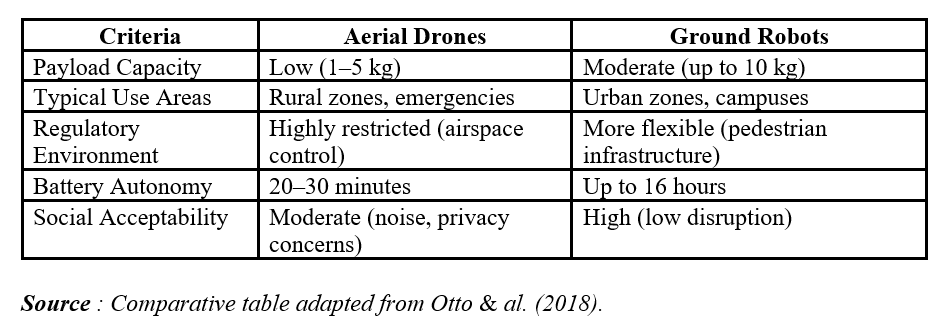
- Payload capacity : Drones are limited by aerodynamic and energy constraints, making them suitable primarily for lightweight, urgent deliveries such as medications or emergency equipment. Ground robots, though not without limitations, can accommodate a wider range of goods including meals, groceries, and small packages.
- Usage zones : Drones are highly effective in hard-to-reach or poorly served areas such as mountains, remote rural locations, or during natural disasters. Ground robots, on the other hand, are optimized for structured pedestrian environments, making them ideal for densely populated urban zones, business parks, or residential districts.
- Regulation : Autonomous aerial delivery is tightly regulated, especially regarding overflight of populated areas, privacy protection, and safety. These restrictions limit widespread use, confining most drone applications to pilot programs. Ground robots face fewer legal constraints, though some cities have begun implementing specific rules (e.g., speed limits, insurance, right-of-way requirements).
- Energy autonomy : Ground robots far outperform drones in terms of battery life. Drones often require recharging after each trip, whereas robots can run continuously for up to a full day, making them well-suited for scheduled or repetitive delivery rounds.
- Social acceptance : Drones still evoke public concerns around surveillance, noise, and safety (e.g., crash risks, interference). In contrast, ground robots tend to be quieter, more visible, and predictable in their movements, earning them higher levels of public trust especially in areas with high pedestrian density.
The academic literature (Otto & al., 2018 ; Goodchild & Toy, 2018) stresses that drones and ground robots are not competitors but complementary tools. Drones serve best in urgent, time-sensitive, or hard-to-access contexts, while robots are better suited to predictable, routine deliveries in urban environments. Their combined use within a smart, multimodal logistics ecosystem could significantly optimize delivery chains by adapting to both geographic conditions and local constraints.
2.5. Deployment Constraints : Regulation, Society, and Cost
One of the major obstacles to integrating these technologies remains regulation. Drone usage in urban areas is heavily restricted by civil aviation authorities. Ground robots, by contrast, are governed mostly by local jurisdictions, which makes it easier to implement pilot projects in semi-controlled environments (Potluri & Vajjhala, 2024). Social acceptance is also critical. Ground robots are generally well received : they’re quiet, non-invasive, and easy to see. Nonetheless, their interaction with pedestrians especially vulnerable groups raises concerns about urban coexistence (Giones & Brem, 2017). On the economic front, several studies suggest a favorable return on investment in the medium term, particularly in densely populated areas where delivery routes are short and repetitive (Joerss & al., 2016).
2.6. Environmental Challenges and Sustainability
One of the strongest arguments in favor of using robots and drones in urban logistics is their electric powertrain, which helps reduce direct greenhouse gas emissions. This marks a meaningful shift in addressing climate concerns. However, this immediate reduction in carbon footprint must be viewed in a broader context : the overall sustainability of these technologies depends on several factors such as the energy source (renewable vs. non-renewable), delivery frequency, and the overall efficiency of the logistics system.
For instance, if drones are used for frequent single-item deliveries, energy savings may quickly be offset by the number of trips required. Additionally, the environmental costs of manufacturing and recycling these devices must also be considered. Researchers like Stolaroff and al., (2018) recommend integrating these technologies into hybrid logistics systems combining drones, robots, and traditional vehicles within urban delivery hubs, pooling deliveries, and optimizing routing to reduce redundancies. A systemic approach is therefore essential if these innovations are to truly fulfill their ecological promises.
2.7. Toward a Hybrid, Automated, and Intelligent Logistics System
Urban logistics is undergoing a deep transformation. A new hybrid model is emerging combining autonomous vehicles, drones, mobile micro-warehouses, and digital platforms powered by artificial intelligence, the Internet of Things, and even blockchain. This convergence of technologies is no longer science-fiction ; it is becoming a reality in some leading metropolitan areas. These tools enable much more granular and responsive logistics management. AI can predict demand spikes, optimize routes in real time, and allocate resources more efficiently. IoT facilitates real-time package tracking, while blockchain improves traceability and operational transparency. According to Hofmann and Rüsch (2017), these innovations support smarter and more agile coordination across the entire supply chain. This evolving model is not just about technical efficiency it also aims for better integration of environmental, social, and economic concerns. In other words, the logistics systems of tomorrow will not only be automated ; they must also be more responsible.
3. Methodology
3.1. Research Approach : Qualitative Case Study
This research adopts a qualitative case study approach, focusing on a single case : the company Starship Technologies. This method, as defined by Yin (2017), is particularly suited to studying emerging phenomena within their real-life contexts, especially when multiple technical, organizational, and social factors interact. Given the still-nascent nature of autonomous delivery robots, this approach allows for an in-depth, contextualized understanding of how such technology is integrated into last-mile urban logistics.
3.2. Research Objectives
The study aims to explore the tangible impacts of autonomous ground robots on urban delivery operations. It is structured around three main questions :
- What measurable benefits do these technologies offer in terms of cost, delivery time, customer satisfaction, and environmental sustainability ?
- What are the key barriers to their adoptio organizational, operational, or regulatory ?
- Under what conditions can their deployment be scaled up in urban settings ?
3.3. Case Study : Starship Technologies
Established in 2014, Starship Technologies serves as the central case in this study due to its trailblazing role in the autonomous delivery sector. As one of the earliest companies to successfully deploy self-driving delivery robots at scale, Starship offers a compelling example for analyzing both technological implementation and societal response. Its operations span multiple countries including the United Kingdom, the United States, Estonia, and Germany with active fleets functioning in urban neighborhoods and university campuses. This geographical and operational diversity provides a rich backdrop for examining how autonomous delivery solutions are adapted to different regulatory, cultural, and infrastructural contexts (Hong & al., 2023).
3.4. Data Collection
Data for this study were gathered remotely over a four-month period, from January to April 2025. A triangulated research design (Eisenhardt, 1989) was employed to enhance the robustness and credibility of the findings by integrating multiple types of data and perspectives. Three primary data sources were utilized :
- Remote semi-structured interviews : A total of eight interviews were conducted with stakeholders across the Starship ecosystem. These included three internal employees representing logistics, engineering, and field operations ; two external partners, a retail business representative and a university collaborator ; and three everyday users of the delivery service. These conversations provided diverse viewpoints on how the technology is developed, deployed, and experienced.
- Digital document analysis : A range of corporate and public documents were reviewed, including internal reports, official presentations, press releases, regulatory guidelines, and municipal policies related to autonomous vehicle deployment in cities such as Milton Keynes, Austin, and London. This material helped contextualize the company’s strategy and adaptation to local governance structures.
- Indirect observation : Observational data were drawn from a variety of digital sources. These included public demonstrations, video footage of robots in action, real-time tracking maps offered by Starship’s app, and user-generated content such as online reviews, forum discussions, and media articles. This allowed for a nuanced understanding of user interaction and public perception, despite the lack of physical site visits.
Although the study was conducted remotely limiting opportunities for in-person fieldwork the triangulated approach yielded a rich and multifaceted dataset. By combining technical, institutional, and user-driven insights, the research was able to paint a comprehensive picture of how autonomous delivery is being integrated into everyday life.
3.5. Data Analysis
To interpret the diverse set of qualitative data collected ranging from interview transcripts and internal documents to online user content an inductive thematic analysis was conducted, following the methodological guidance of Engle (2015). Rather than starting with a rigid analytical framework, the research embraced an open, exploratory approach. This allowed key patterns and insights to emerge organically from the data, ensuring that the analysis remained grounded in real-world experiences rather than constrained by predefined categories.
The analysis was carried out iteratively, with repeated cycles of reading, coding, and theme refinement. Specialized qualitative analysis software, such as NVivo or Atlas.ti, was used to organize and cross-reference the data efficiently. These tools enabled the integration of different types of input, such as textual content from interviews, written documents, and digital observations into a cohesive analytical process. This triangulation across sources helped to enhance both the depth and the reliability of the findings.
Through this process, three core thematic areas emerged as central to understanding the impact and implications of autonomous delivery systems :
- Logistical Performance : This theme captures the measurable outcomes of robot deployment on delivery operations, including improvements or changes in delivery times, cost reductions, consistency of service, and overall reliability. These indicators provided insight into how automation affects day-to-day efficiency within the logistics chain.
- Organizational Impacts : The second theme reflects internal transformations prompted by the adoption of autonomous technologies. It includes the restructuring of workflows, the emergence of new job roles such as remote operators and robot technicians, and the development of new technical and managerial skills required to support these changes.
- Social Acceptability : Finally, the third theme deals with how various stakeholders including users, partners, and the general public perceive and interact with autonomous delivery systems. It encompasses issues of trust, the robot’s integration into shared public spaces, ethical concerns, and broader societal responses.
This thematic structure provided a rich, nuanced understanding of how autonomous delivery technologies are not only implemented but also received, negotiated, and adapted in practice.
4. Findings and Discussion
4.1. Operational Improvements
Evidence gathered through remote interviews and internal documentation points to a notable decline in delivery-related expenses estimated between 20% and 30% following the integration of autonomous delivery technologies (Reinhardt & al., 2024). Several key factors drive these savings. First, the use of energy-efficient delivery robots significantly reduces fuel and maintenance costs. Second, these robots can operate continuously, without the need for breaks or shift rotations, thereby increasing operational uptime. Third, sophisticated route optimization algorithms help streamline navigation, minimizing unnecessary travel and reducing delivery times.
These insights align closely with findings from recent academic literature, which estimate potential savings in last-mile delivery operations ranging anywhere from 15% to 80%, depending on the specific urban context, infrastructure maturity, and delivery density (Zemanek & Kros, 2025 ; Alverhed & al., 2024). In high-density urban areas, for instance, where traffic congestion and labor costs are significant challenges, automation can yield particularly strong economic benefits.
Beyond the delivery sector, large-scale adopters like Amazon have reported transformative impacts from automation across their operations. According to Tien and al., (2025), Amazon has achieved up to 25% cost reductions in warehouse management through the integration of robotics, translating into billions of dollars in projected annual savings. These developments underscore the broader potential of automation not just to streamline individual processes but to fundamentally reshape operational efficiency across the entire supply chain.
4.2. Logistics Process Reorganization
Implementing autonomous robots in logistics is not a simple plug-and-play process ; it requires a comprehensive reorganization of existing systems and workflows. The transition demands significant adjustments in three primary areas : physical infrastructure, digital systems, and workforce roles.
- Physical Infrastructure : Partners and local stakeholders must modify existing environments to support autonomous navigation. This includes the installation of dedicated loading and unloading bays, pathway markings, and signal systems to ensure robots can move safely and efficiently through both indoor and outdoor spaces.
- Order Management Systems : Existing logistics and warehouse platforms must be adapted to accommodate the functional limitations and behaviors of delivery robots. For example, software must now account for lower carrying capacities, slower travel speeds, and more frequent delivery intervals. Integration with robotic fleets also requires enhanced synchronization between inventory systems, route planning tools, and customer interfaces.
- Human Resource Transformation : Rather than replacing humans, automation introduces new roles and responsibilities. Emerging job profiles such as robot handlers, fleet coordinators, and remote operators are becoming essential. These positions require specialized training, often blending technical knowledge with logistical expertise. The shift also demands cultural adaptation within organizations, as human workers learn to collaborate with robotic systems in shared environments.
As highlighted by Büyüközkan and al., (2023), the long-term success of such transformations depends not only on the technical capabilities of the robots themselves but also on user trust, ease of integration, and the overall perceived usefulness of the system. Without alignment between technology, infrastructure, and human experience, even the most advanced solutions may struggle to scale effectively.
4.3. User Feedback and Perceptions
Feedback collected through user interviews and analysis of online discussions suggests that public attitudes toward autonomous delivery robots are largely favorable. Many users express appreciation for the robots’ friendly and approachable design, which avoids the intimidating appearance sometimes associated with advanced technology. Their quiet, almost discreet operation, combined with predictable behaviors such as stopping at pedestrian crossings or yielding to foot traffic also contributes to a sense of safety and reliability.
However, this overall positivity is tempered by several recurring concerns. Pedestrian safety remains a key issue, particularly when robots operate near vulnerable populations such as children, elderly individuals, or people with disabilities. The use of shared sidewalks raises additional worries about congestion, especially in densely populated urban areas where foot traffic is already high. Another area of concern is the potential impact on employment, as automation increasingly replaces roles traditionally performed by humans sparking broader ethical and societal questions about the future of work. Research by Yuen and al., (2022) supports these observations, emphasizing that while functional aspects like speed and reliability are primary drivers of acceptance, social and emotional responses such as trust, comfort, and perceived fairness continue to shape how people relate to new technologies. In other words, successful adoption isn’t just about performance ; it’s also about how the technology fits into the social fabric of daily life.
4.4. Barriers to Deployment
Despite encouraging results in pilot programs and limited rollouts, the path to widespread deployment of delivery robots remains complex and fraught with challenges. Several practical and structural limitations continue to restrict scalability.
- Sensitivity to Weather Conditions : Most autonomous delivery robots struggle in adverse weather. Rain, snow, and icy surfaces can interfere with sensors and hinder mobility, reducing their effectiveness during much of the year in certain regions.
- Payload Limitations : Current robotic models are designed to carry relatively light parcels typically under 10 kilograms. This restricts their utility to a narrow segment of deliveries, limiting their value for retailers or services dealing with bulkier or heavier goods.
- Urban Infrastructure Constraints : The effectiveness of autonomous robots is highly dependent on local infrastructure. They require wide, smooth, and obstacle-free sidewalks conditions that are far from universal across cities. In neighborhoods with uneven pavement, narrow walkways, or frequent obstructions, robots may face significant operational barriers.
- High Initial Costs : While robots may promise long-term savings, the upfront investment required to get them operational is considerable. Costs associated with purchasing the hardware, training staff, installing digital infrastructure, and adapting facilities can be prohibitive particularly for small and medium-sized enterprises (SMEs) or municipalities operating on tight budgets.
Banjanović-Mehmedović and al., (2023) underscore that although projected long-term savings can reach up to 80%, these benefits cannot be fully realized until key short-term obstacles are addressed. This will require not only technological innovation, but also supportive urban planning, inclusive policymaking, and collaborative public-private efforts to ensure that the infrastructure and social environment are ready to accommodate these emerging technologies.
4.5. Critical Discussion
The research findings strongly support the viability of autonomous delivery robots as a promising solution for addressing the persistent challenges of last-mile logistics in urban settings. Particularly in cities with dense populations and well-developed infrastructure, these robots offer tangible benefits ranging from reduced delivery costs to improved operational efficiency and lower environmental impact. Their ability to navigate short urban distances autonomously makes them especially well-suited for high-frequency, low-volume deliveries such as groceries, meals, or small parcels. However, the long-term success of this technology is far from guaranteed. It hinges on the presence and quality of three critical enabling factors that extend beyond technical performance :
- Infrastructure Readiness : For autonomous robots to operate reliably and safely, cities must provide consistent and well-maintained pathways. Sidewalks need to be wide enough, free of obstructions, and built to accommodate shared use by pedestrians and robots alike. Interruptions such as curbs, potholes, or clutter can severely disrupt service and pose risks to both the robots and the public.
- Regulatory Clarity : Legal frameworks have not yet caught up with the pace of technological advancement. In many jurisdictions, issues such as liability in the event of an accident, robot rights of way, data privacy, and public space usage remain ambiguous. Without clear and enforceable guidelines, both companies and municipalities face uncertainty that can hinder investment and deployment.
- Social Acceptance and Integration : Perhaps the most complex challenge lies in gaining and maintaining public trust. People must feel comfortable sharing space with delivery robots and confident that these technologies serve community needs. Achieving this requires more than effective engineering, it demands transparent communication, ongoing citizen engagement, and the flexibility to tailor implementations to local cultural and social contexts.
Zhu and al. (2023) emphasize the importance of participatory approaches and real-world data transparency in building legitimacy. By involving citizens early in the planning and testing stages and openly sharing performance and safety data, organizations can foster trust and demonstrate accountability. Without these social and regulatory foundations, even the most advanced robotic solutions may face resistance or stagnation in public deployment.
5. Conclusion
This research brought together a thorough review of the academic and industry literature with an in-depth case study focused on Starship Technologies to explore how autonomous vehicles and drones are reshaping the landscape of last-mile urban logistics (Esteve Rubio, 2023). The findings highlight that these technologies are more than just futuristic tools, they represent a transformative shift in how goods can be delivered within cities.
The evidence points to a range of operational benefits. Autonomous delivery systems can lower logistics costs, reduce delivery times, and streamline supply chain processes. However, their impact extends far beyond technical efficiency. These innovations are catalysts for broader organizational and societal change. They prompt a rethinking of logistics workflows, necessitate new job roles and technical competencies, and demand careful integration into the social and regulatory fabric of urban life.
Importantly, the success of autonomous delivery solutions depends not solely on technological readiness. Equally critical are the surrounding conditions, namely, the presence of adaptable infrastructure, coherent and forward-looking governance, and the active engagement of citizens and stakeholders. Public acceptance, trust, and awareness play central roles in ensuring that these systems are welcomed and used meaningfully.
While this study is limited in scope focused on a single case and relying on remote data collection, it nonetheless offers actionable insights into the key enablers and barriers to implementation. It underscores that innovation must be accompanied by inclusive planning and context-sensitive adaptation.
To that end, several practical recommendations emerge :
- Promote collaborative frameworks between governments and private-sector actors to establish agile, secure, and transparent regulatory environments.
- Invest in urban upgrades such as designated drop-off zones, charging infrastructure, and dedicated pathways to accommodate autonomous vehicles safely.
- Support workforce transition by providing training programs and resources that prepare people for emerging roles in robot operations, maintenance, and oversight.
- Raise public awareness through outreach and education campaigns to build trust, dispel myths, and foster a culture of openness toward innovation.
- Pursue complementary integration of ground-based robots and aerial drones, adapting deployment strategies to the specific spatial and logistical characteristics of each urban area.
Looking ahead, future research should aim to broaden the analysis across multiple cities and regions, examine long-term economic and environmental outcomes, and investigate how these technologies can align with wider urban priorities such as sustainability, equity, and resilience.
In conclusion, while autonomous delivery systems are not a one-size-fits-all solution, they represent a powerful opportunity to rethink urban logistics. If deployed thoughtfully with attention to infrastructure, governance, and human factors, they could help create smarter, more responsive, and more sustainable cities.
Bibliographie
- Alverhed, E., Hellgren, S., Isaksson, H., Olsson, L., Palmqvist, H., & Flodén, J.(2024). “Autonomous last-mile delivery robots : A literature review.”European Transport Research Review, 16(1), 4.
- Banjanović-Mehmedović, L., Husić, L., Husaković, A., & Sarajlić, N. (2023, May). FPGA based logistics service robot control in e-commerce warehouse system. In International Conference “New Technologies, Development and Applications” (pp. 461-469). Cham : Springer Nature Switzerland.
- Büyüközkan, G., Uztürk, D., & Maden, A. (2023). Influential factor analysis for cloud computing technology service provider. Technological forecasting and social change, 192, 122531.
- Eisenhardt, K. M. (1989). Building theories from case study research. Academy of management review, 14(4), 532-550.
- Engle, M. (2015). Book review : Qualitative data analysis : A methods sourcebook : The coding manual for qualitative researchers.
- Esteve Rubio, M. (2023). Study of the benefits and applications of passenger supersonic transport vehicles : Case Study of Starship-SpaceX (Bachelor’s thesis, Universitat Politècnica de Catalunya).
- Gevaers, R., Van de Voorde, E., & Vanelslander, T. (2014). Cost modelling and simulation of last-mile characteristics in an innovative B2C supply chain environment with implications on urban areas and cities. Procedia-Social and Behavioral Sciences, 125, 398-411.
- Giones, F., & Brem, A. (2017). Digital technology entrepreneurship : A definition and research agenda. Technology innovation management review, 7(5), 44-51.
- GoGoodchild, A., & Toy, J. (2018). Delivery by drone : An evaluation of unmanned aerial vehicle technology in reducing CO2 emissions in the delivery service industry. Transportation Research Part D : Transport and Environment, 61, 58-67.
- Hofmann, E., & Rüsch, M. (2017). Industry 4.0 and the current status as well as future prospects on logistics. Computers in industry, 89, 23-34.
- Hong, C., Choi, E. K., Joung, H. W., & Kim, H. S. (2023). The impact of customer perceived value on customer satisfaction and loyalty toward the food delivery robot service. Journal of Hospitality and Tourism Technology, 14(5), 908-924.
- Joerss, M., Schröder, J., Neuhaus, F., Klink, C., & Mann, F. (2016). Parcel delivery : The future of last mile. McKinsey & Company, 1-32.
- Lozzi, G., Iannaccone, G., Maltese, I., Gatta, V., Marcucci, E., & Lozzi, R. (2022). On-demand logistics : Solutions, barriers, and enablers. Sustainability, 14(15), 9465.
- Otto, A., Agatz, N., Campbell, J., Golden, B., & Pesch, E. (2018). Optimization approaches for civil applications of unmanned aerial vehicles (UAVs) or aerial drones : A survey. Networks, 72(4), 411-458.
- Potluri, R. M., & Vajjhala, N. R. (2024). Efficiency Benchmarking Through Data Envelopment Analysis : Evaluating Disruptive Technologies in India’s Key Sectors. In Data Envelopment Analysis (DEA) Methods for Maximizing Efficiency (pp. 161-183). IGI Global Scientific Publishing.
- Reinhardt, J. C. V., Dewes, M. D. F., Gonçalez, O. L., & Lahoz, C. H. N. (2024). SpaceX Starship SN10 Prototype Safety Analysis : A Case Study on Organization’s Needs Management. Journal of Aerospace Technology and Management, 16, e3724.
- Stolaroff, J. K., Samaras, C., O’Neill, E. R., Lubers, A., Mitchell, A. S., & Ceperley, D. (2018). Energy use and life cycle greenhouse gas emissions of drones for commercial package delivery. Nature Communications, 9(1), 409.
- Sung, J., Christensen, H. I., & Grinter, R. E. (2009, March). Robots in the wild : understanding long-term use. In Proceedings of the 4th ACM/IEEE international conference on Human robot interaction (pp. 45-52).
- Tien, N. H., Thao, P. N., & Thanh, T. T. L. (2025). The Impact of AI on Logistics Performance of Enterprises. Cuestiones de Fisioterapia, 54(5), 451-464.
- Tom, N. M. F. (2020). Crashed ! Why drone delivery is another tech idea not ready to take off. International Business Research, 13(7), 251-251.
- Yin, R. K. (2017). Case study research and applications : Design and methods. Sage publications.
- Yuen KF, Cai L, Lim YG and Wang X (2022) Consumer acceptance of autonomous delivery robots for last-mile delivery : Technological and health perspectives. Front. Psychol. 13 :953370. Doi : 10.3389/fpsyg.2022.953370.
- Zemanek Jr, J. E., & Kros, J. F. (2025). Risk-Mitigation Strategies for Autonomous Delivery Vehicles in the Last Mile : A Comprehensive Overview of the Current State and Future Potential of Autonomous Delivery Technologies in the Supply Chain. Journal of Comprehensive Business Administration Research, 2(2).
- Zhu, X., Cai, L., Lai, P. L., Wang, X., & Ma, F. (2023). Evolution, challenges, and opportunities of transportation methods in the last-mile delivery process. Systems, 11(10), 509.